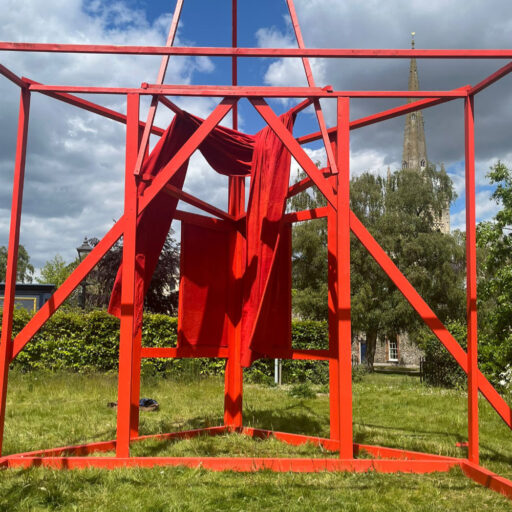
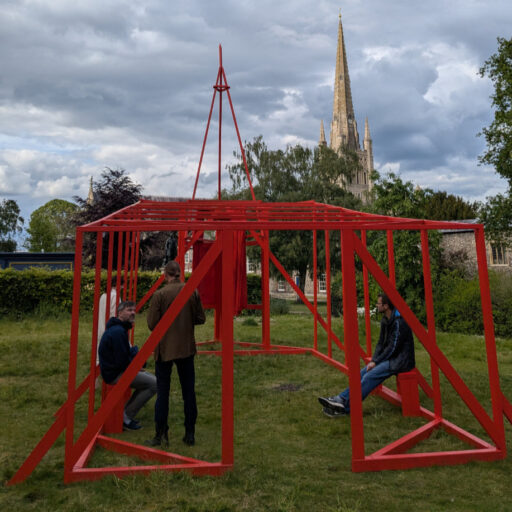
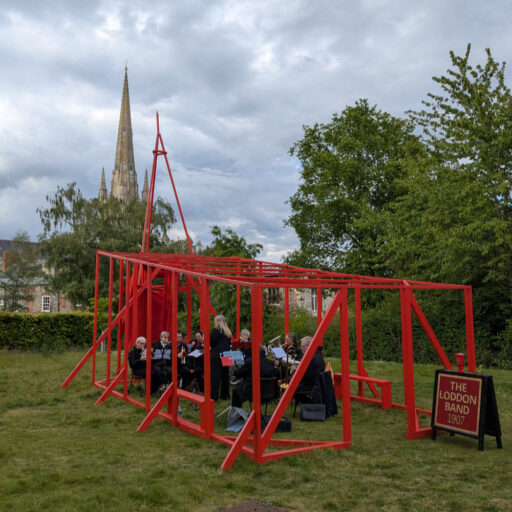
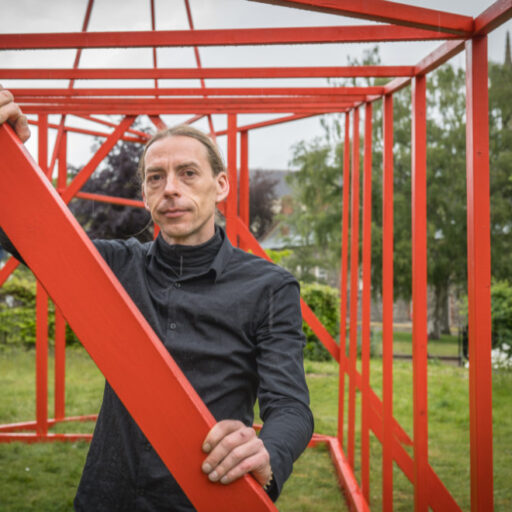
The Cloak of St Martin is an installation by Hardy Gru at Almary Green at The Close at Norwich Cathedral. The red cloak of St Martin is displayed within a wooden church-like structure. Visitors can enter the structure, and sit and reflect on its form and space.
Hardy Gru is interested in site-specific art, and has been commissioned by the Cathedral in partnership with St Martins to create an installation that reflects the mission of the charity, and the wider community’s response to people experiencing homelessness in the city.
Site-specific art
The name ‘Almary Green’comes from its proximity to the almonry — the place where alms (charity, food, aid) were distributed. Almary Green was once the site of a church (St Ethelbert’s), which existed before the cathedral was built, and was destroyed in 1272 during civic unrest.
The artwork takes the form of a wooden structure that echoes the outline of a church. Built from timber and painted red, the structure stands openly in the green field, suggesting both the memory of a sacred building and the trace of something that once existed on this ground. Rather than recreating a church, the installation presents its skeletal form — a light architectural drawing in space that invites reflection on absence, history, and community.
What is the cloak of St Martin?
Suspended within this open structure is a large cloak, hanging from the upper beams. Inspired by the story of Martin of Tours, who divided his cloak to shelter another, the work reimagines this gesture as a communal process. The cloak is formed from donated fabrics, each carrying traces of previous lives. Cut, stitched, and assembled, these fragments become a shared surface — a shelter shaped by many hands.
St Martin was a 4th century Roman soldier who is best known for his act of charity; one cold winter day, he encountered a beggar shivering in the streets. Moved with compassion, he cut his military cloak in half and shared it with the man. That night, Martin reportedly had a vision of Jesus wearing the halfcloak. Martin carried on his life caring for people in need.
What does it mean?
By placing this symbolic cloak within the outline of a church that no longer stands, the project reflects on the idea that acts of care are themselves forms of architecture.
The installation proposes that shelter is not only a physical building but also a human act — one that continues to shape communities today. The St Martins community has contributed to the construction of the cloak, showing that we all form the shape of how we support each other and live together.
How the installation took shape
The Cloak of St Martin is part of the Benedictine Art Project, which was initiated by Norwich Cathedral in collaboration with English+, St Martins, the Diocese of Norwich Education Department and Norwich University of the Arts, supported by a grant from the Farmington Institute, Oxford. The project features work by artists Hardy Gru, Deborah Tompsett, and Lily Bunney.
The Cloak of St Martin was developed through a series of workshops with residents and team members of St Martins alongside local artists and public participants.
The first sessions focused on materials and shapes — exploring fabric through cutting, layering, and composition. The second shifted to site, body, and objects, considering how the work relates to space and how it might be experienced.
Through this shared process, participants exchanged perspectives on the site and its histories. The cloak emerged collectively, carrying multiple voices while extending the ethos of St Martin’s Housing Trust into a space of learning, participation, and connection.